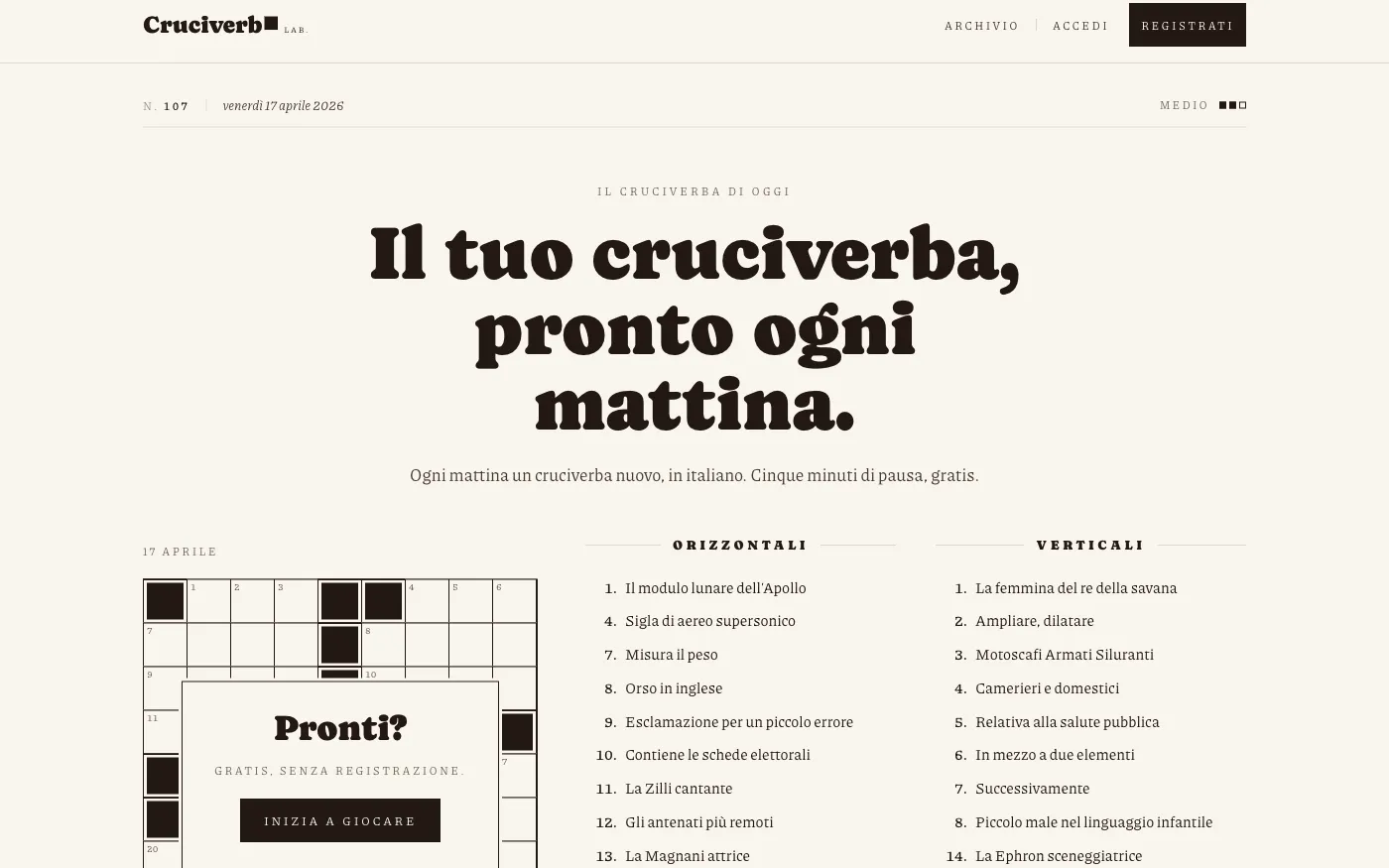
Why another crossword?
T he Italian crossword tradition is deep: Settimana Enigmistica, Domenica del Corriere, decades of elegant grid design. But the online experience had quietly migrated to the worst of the 2010s web: PDF downloads, pop-ups, subscribe-walls over half the page.
I wanted the opposite. A URL. A grid. A pencil.
In April that was all of it. Then the grid asked for company.
From rite to newsstand
The daily crossword is still the centre, with its rules intact: hand-written clues, no timer staring you down, no streak shaming you at 11:47 PM. Around it, though, a whole puzzle page has grown. Chiave is Wordle in Italian, Nessi is Connections, Alveare is the Spelling Bee, Setaccio a themed word search. Then the games from Italian TV, Ghigliottina and Catena, and Mosaico, a solitaire played with Neapolitan cards and scored like scopa. Every week the Maxi and the 30×30 Mega arrive.
Everything drops at midnight, plays as a guest, and feeds one leaderboard, daily and monthly. Registering keeps your times and a level. There is also an edition for people learning Italian: A1, A2 and B1 packs, native audio, clues translatable into five languages.
Premium unlocks the archives, the packs by difficulty, and past crosswords you can download and play offline: €4.99 a month or €39.99 a year. That is still the whole business.
The design
The brief was simple: make the grid feel like paper, not a CRUD form.
- Type
- Serif display across every heading. This is a puzzle, not a dashboard.
- Columns
- Numbered clue columns typeset like a printed magazine, not a bulleted list.
- Contrast
- Muted off-white canvas, deep black grid. High contrast where it matters; quiet everywhere else.
- Chrome
- None. The grid, the clues, the day's number. Eight games later, that is still the interface.
The stack
- Nuxt
- One codebase, SSR by default. Over 8,400 URLs in the sitemap, all rendered on the server: that is why Google reads them.
- TypeScript
- Cell state, cross-references, active direction, validation, autosave. Types earn their keep by the second week, and by the second game.
- PostgreSQL
- Every game is a structured document with a date. Queries by date, difficulty, completion, leaderboard.
- Tailwind
- Used as a design-token layer, not a utility dump. Every class maps back to the typographic scale.
- Editorial pipeline
- Eight games a day only hold up with editing tools: generation, verification, scheduling, and a human re-read of every clue.
- The solutions
- The day after publication, every clue becomes a page with its answer and a note explaining it. That is 7,800 pages and 115,000 impressions a month: the site's SEO engine is its own archive.
What five months taught me
Numbers first, for once. In May, Google showed the site thirty times a day. In September, seventeen thousand. No campaign, no bought links: one edition every night, pages that answer one precise question, and a domain that had time to earn its place.
Building a product with a rhythm is still different from building a feature. There's no version 2 of Tuesday's grid. It was Tuesday, and then it was gone. Every day is a ship date. It's still the best part.